Clearing an Overgrown Lot or Fence Line: Mulcher or Hand Crew?
The machine that clears an acre of brush in an afternoon is the wrong tool for a flower bed.
October 8, 2026 · 4 min read
Give East Texas brush a couple of wet summers and it takes over. Privet, briars, young sweetgum and yaupon crowd a fence line, climb the wires, and swallow the back of a lot until you can't see where your property ends. Clearing it is a different kind of job than mowing. It is slow with hand tools and fast with the right machine, but the right machine isn't always the right answer.
Why brush gets out of hand so fast
Birds drop seeds along fence lines, and a fence gives young plants something to climb. A lot that was mowed twice a year becomes a thicket in three or four, and once saplings are an inch thick at the base, a mower or a string trimmer can't touch them. The longer you wait, the bigger the job gets, and the more it costs in time and effort to put right.
What a forestry mulcher does
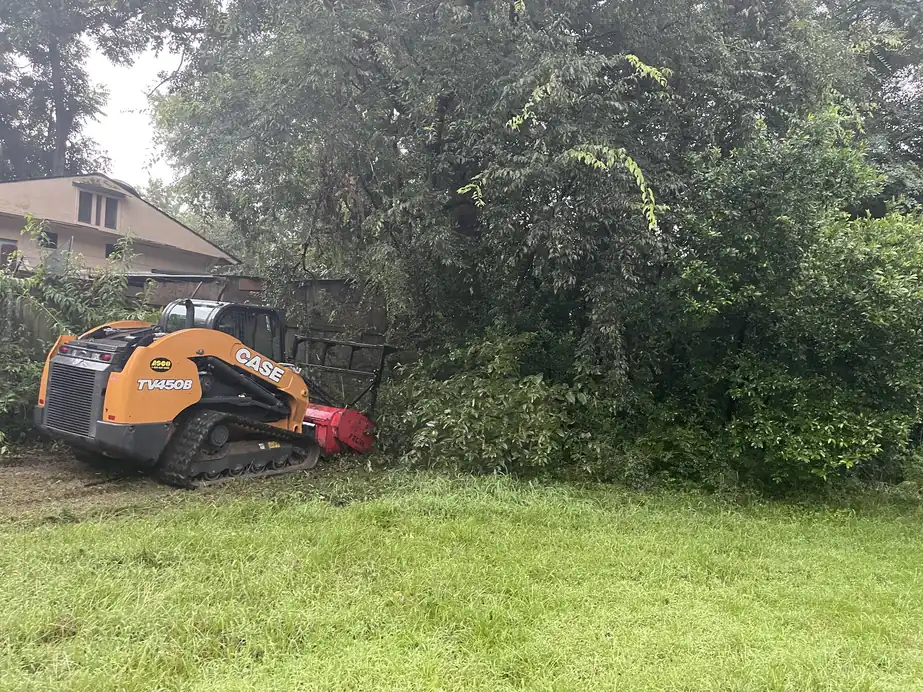
Polo runs a CASE compact track loader fitted with a forestry mulcher head. The head is a spinning drum with teeth. It grinds brush and small trees right where they stand and leaves the chips on the ground as a layer of mulch. There is no burn pile and no truckload of limbs to haul. The ground ends up covered in shredded wood instead of a wall of growth.
Polo's photos show it at work, chewing into a thick wall of overgrowth behind a house. It is the kind of job that would take a hand crew days of chainsaw work and hauling.
When the mulcher is the right call
- A back lot or acreage that has gone to brush and young trees, with no landscaping worth saving.
- A long fence line choked with vines, briars and volunteer saplings.
- Ground you want to open up for mowing, a pasture, a building site or a view.
- Places where burning isn't practical and hauling would cost more than the clearing itself.
Tracks spread the weight of the machine out, which helps on soft or uneven ground. A tracked loader can get into places a truck and trailer can't.
When hand clearing wins
A mulcher is a blunt instrument, and sometimes you want a fine one. Hand clearing is better in tight spots and anywhere there is something worth protecting.
- Right against a fence, a house, a well house or a shed.
- Around mature trees you want to keep, especially where their roots run close to the surface.
- Near flower beds, sprinkler heads and anything else that doesn't like being hit by a machine.
- Small patches where bringing a loader in costs more than the job is worth.
Most real jobs use both. The machine does the heavy lifting in the open, and chainsaws, trimmers and hand tools finish the edges.
Before the work starts
A little prep saves a lot of trouble. Walk the area and decide what stays. Flag the trees you want to keep with ribbon. Know where your property line is, and talk to a neighbor if the fence is shared. Tell whoever is doing the work about anything buried or hidden in the brush: a septic line or tank lid, a water line, a sprinkler system, old fence wire, a buried cable.
Old fence wire and cable are the surprises that hurt equipment and people. If you know the history of the lot, say so. If you don't, say that too.
Staying safe around the work
A mulcher throws chips and sometimes small chunks of wood. Keep children, pets and cars well back from the work area, and don't wander in to look at progress while the head is spinning. If you can see the machine, wave from a distance and wait for the operator to stop. The same goes for the hand crew with chainsaws.
What the ground looks like afterward
Mulching leaves a rough, chipped surface with stumps cut low, not a finished lawn. The roots stay in the ground, and cleared brush wants to grow back, especially vines and fast-sprouting saplings. Plan on mowing the area regularly in the first season so the regrowth never gets a head start. Polo's photos of a cleared rural lot show the next stage: cut ground with fresh debris lines, ready to be kept up.
If you want a clean fence line or a usable lot, start by getting someone out to look. Customers say Polo texts to ask for the address and then comes by to see the property. Several reviewers mention same-day visits. When you reach out, a few details help: roughly how long the fence line is or how big the lot is, what is growing there, and what you want it to be when it's done. Send a photo of the area if you can, and call or text Polo at (903) 245-6122 for a free estimate.
Polo Lawn Services, (903) 245-6122
Call (903) 245-6122